Making Jam


I have rediscovered making jams and jellies! After making soap, jam is so simple, quick and easy! It's been a few years since I made jam, but it's something that comes back easily. I'm having fun making jams from just about everything. It's a creative outlet. I have learned to make jam from anything, even herbs. It doesn't require any more than a strong, steeped tea made from whatever. I think squash or pumpkin with the spices would make great jam! I haven't gone there yet, but it's possible.

I'm using Ball pectin for the first time. It wasn't around when I was making jams and jellies before, many years ago. I like it! It works by the teaspoon, and I use the low sugar pectin. Not necessarily because I want to put in less sugar, but because it always gels, unlike the old, classic pectin. I do make less sugar jams, however. Not low sugar, just less, sometimes half of the recipe. The very low sugar jams don't keep as long on the shelf. It still needs a lot of sugar as a preservative. I also add the lemon juice to everything. You can't make safe jam without it. The acid is necessary for the pectin to gel, as well as working as a preservative. 

I have them for sale at the local Farmer's Market. The first one I made recently was Hummingbird Jam. It's pineapple, banana and coconut. It's very thick and I used all the called for sugar, since I was using classic pectin and not the low sugar kind. It's delicious, although a bit thicker than I would have liked. I have reduced the amount of pectin that Ball recommends as I found it makes the jam too thick. 


Currently I have the above Hummingbird Jam, Cantaloupe, Apple, Honeydew-Pomegranate, seedless Raspberry, Strawberry-Banana, Strawberry-Rhubarb, Red-Grape, Real-Orange. I named it "Real Orange" so it's not confused with the creamsicle orange flavour out there. It's made from the juice of real oranges. I have sold some of the orange to people who wanted to glaze their Christmas cakes with it. There are so many things you can do with jams! Glazing pork with the apple jam, or any baking with the seedless, extra thick raspberry. It would also be excellent on cheesecake! I recently made a pot of orange chicken. It was delicious! 


It's so easy to make jam or clear jelly, although the clear part takes a bit more work. I run the hand blender through all my fruits thoroughly first. I don't like large lumps of fruit in my jam. It doesn't spread well like that. It also helps mix together the ones with more than one kind of fruit. I do the mixing in the bowl first, adding the pectin to the cold fruit before blending. The blender also does a good job of mixing in the pectin powder. DO NOT add the sugar at this point. Just the pectin and the lemon juice and any other additives that are going in. I use a coconut baking emulsion for the coconut flavour. It's made with real coconut and, wow, does it ever taste like real coconut. It's twice as strong as extract so you don't need much. It tastes better than extract and doesn't evaporate when heated like an alcohol based extract does. It comes in other flavours. I used to have cherry, and it was amazing! I have made cherry pie jam, previously, adding almond extract to it and the almond came through well, so extract will work too. You can use powdered spices, as well, like you would do in a pumpkin pie jam. I would add those before using the blender, just to make sure they were well mixed. There are just so many things you can do with jams! 

To make clear jellies, you only use the juice. It has to be strained very well through cheesecloth to get it clear. Then make the jelly from the juice. You can make jelly with flower petals too, like dandelion or rose, making a strong, steeped tea. It gets well strained and the jelly made from the tea. It's something I will do in the spring, when my yard is full of dandelions that don't get sprayed and the wild roses on the fence are blooming. The jelly in the spoon at the top, is made from red bee balm! It has a minty flavour and was great on beef! I have made grape jelly from Welches Grape Juice that I bought at the store, and I made it in the microwave! Homemade jams are so much better than commercial ones from the store. I don't know why that is. Maybe it's all those chemicals they have to add as preservative? There has to be some reason why they just don't have the same flavour! 

I put all my jams and jellies through the waterbath canner for a full 10 minutes. I know it's not necessary and decades ago we didn't do it that long. Ten minutes is the recommended time for jams that are being sold to the public, so that's what I do. I only make jam in the smaller jar sizes, I'm not canning quart jars, so I took the handles off the rack in my waterbath canner. I can put them back on if I'm ever going to can in the quart jars. I found I can put a lot more of the 250 ml jam jars in the canner without the handles. I just used the small pliers and opened the loop so it slipped off. I can hook it back on and close the loop if needed.

You don't have to use an actual waterbath canner, although I do, but the water has to be at least a full 1.5 inches above the tops of the jars for it to seal properly. If you are getting some jars not sealing, check your water level. This requires a very tall pot and you will need to put something on the bottom so the jars are not setting on the pot bottom, right on top of the burner. I have seen the rings used for this and also a towel folded and set in the bottom, as well. I tried the towel method, but it put a lot of lint into the water. That's not going to hurt your jam, but it does leave it on the jars when removed and it has to be wiped off. It does work, however, and I have to wipe the very hard water stain off the jars, after they cool, anyway. It's a good way to sterilize your tea towels or wash cloths. I use the rack now but when I was using another tall pot, I had to improvise something on the bottom. I think I used the rings. It's hard to remember, now, how that went. 

Use Those Raspberries!


Our raspberries are ready! We love the tart, fruity flavour of fresh raspberries! A few raspberries added to things can raise the flavour to a whole new level.We have three large red raspberry bushes, producing for the first time this year. We have purchased our fresh raspberries in the past. These bushes have produced enough berries to make one pie and one small cobbler, so far.

This is my recipe for raspberry pie filling. This makes two pies:

9 cups washed berries
3 cups sugar
1 cup flour

Cook on top of stove until thickened. Pour into prepared crust and bake at 350F for 45 mins.
I also made a raspberry cobbler with the filling I had left. I just cooked a pot of filling from the amount of raspberries that I had saved. I picked them every day as they ripened and just kept adding them to the bucket in the freezer until it was full. I cooked them in a pot, sweetened to taste and thickened with flour dissolved in a little cold water until it was sweet and thick enough for pie. I filled the pastry and had enough left for the cobbler too.


If I don't have enough of a fruit for a pie, I make a cobbler. A cobbler is a baked fruit thing without a bottom. (A flan is a baked fruit thing without a top.)

I have been using this cobbler recipe since I was in high school. Its the best one I have ever used and it is so simple and easy!

It is very thick and is just spooned on top like biscuit dough.
This is my cobbler recipe. I make it in a loaf pan.

4 cups sweetened berries or enough to fill a loaf pan about 1/3 full.
1 cup flour
1/2 teaspoon salt
1/4 cup soft butter
1/2 cup sugar
1 1/2 teaspoon baking powder
1/2 cup milk

Combine dry ingredients with butter in a mixing bowl then add the milk and mix with mixer until well blended. Spoon on top of fruit in loaf pan. Bake at 375F for 45 minutes.


You can also make raspberry wine and raspberry cordial or liqueur. I collected enough berries, with the addition of some wild black ones, to make some raspberry liqueur. I just put the washed berries in a lidded jar and covered them with tasteless alcohol (vodka works for this) and added a little sugar. Its sweetened to taste. You might want to put a lot in. They will sit in there for about six weeks while I am going to shake it daily or whenever I think of it. When the six weeks are up, it will be strained and bottled and left to age. It can be imbibed immediately, but gets mellower with age. After a year it will be fabulous! I don't think it will be here in a year. You can pour this over ice cream or other desserts and light it for a fancy dinner.

Raspberry jelly is also a favourite at our place. I run the berries through the juicer first, then make jelly with the juice, sugar and certo. I didn't have enough berries this year. I still have a few dozen jars of strawberry and peach freezer jam from two summers ago, sitting in the freezer. We don't eat very much jam.


Any leftover raspberries get frozen in ice cube trays. I freeze everything in ice cube trays. I have bags and bags of frozen cubes of all kinds in the freezer.

Frozen cubes of rapsberries make great
blender drinks on a hot day!

Crabapple Jelly


I picked these crabapples yesterday morning! I drove about 20 mins to a friends house and picked them in the park across the street from her house. There were tons of beautiful, ripe crabapples there! These are the big kind, 1.5 - 2" across! I only need about 15 to 20 lbs to make crabapple wine, which is about two buckets full. I knew there would be a lot of waste, so I picked more than I needed.

After sorting and cleaning, I had about the right amount. Some were still a bit too green to use for wine, although they would be great for jelly. There is more pectin in the slightly green ones.

The secret to making good jelly from the very tart, wild things is to use only the clear juice, without any pulp in it. Use a very fine strainer or straining bag and do not squeeze it. This includes, but is not limited to, rhubarb, wild grape, crabapple and choke cherry (which I fully intend to make next year). It probably also includes wild strawberries and a few other things as well.

These things usually have a lot of acid or tannin which is what makes them so tart. So I don't usually add acid to the recipe, although I will for the crabapple, I think. Raw apples, as a general rule, are low in acid. I have a new acid tester now, so I can test the finished juice after boiling and straining and add just the right amount of sugar to it.

I have enough to make crabapple jelly! (It's TIME that I don't have!) Maybe I will just put those in the freezer for now and make jelly later. No pectin is needed for apple jelly. Apples have a lot of their own pectin. As a matter of fact, you can make pectin for general use from apples and crabapples, if you have enough.

Crabapple Jelly Recipe

8 cups fresh crabapples
water as needed
3 cups white sugar

1.Remove stems and blossom ends from crabapples, and cut into quarters. Place them in a large stainless steel or other non-reactive pot or saucepan. Add enough water to be able to see, but no so much that the crabapples are floating. Bring to a boil, reduce heat to medium, and let simmer for 10 to 15 minutes. The apples should soften and change color.
2.Strain the apples and juice through 2 or 3 layers of cheese cloth. Do not squeeze. Use just the clear juice. You should have at least 4 cups of juice. Discard pulp, and pour the juice back into the rinsed pan. Bring to a simmer, and let cook for 10 minutes. Skim off any foam that comes to the top. Next, stir in the sugar until completely dissolved. Continue cooking at a low boil until the temperature reaches 220 to 222 degrees F (108 to 110 C). Remove from heat.
3.Pour the jelly into sterile jars leaving 1/4 inch headspace. Process in a hot water bath to seal.

Drying Herbs & Spices


Gather the herbs you want to use. This is what grows here that I use: plantain, dandelion leaves, horsetail, sow thistle leaves, yarrow leaves, calendula whole blossoms, lavender, rose, spruce, lemongrass, rosemary, peppermint, clover (white and red flowers and leaves), cayenne , goldenrod, fireweed, stinging nettle, thyme, oregano, ground ivy (also called creeping Charlie), usnea lichen, chamomile. I also use feverfew and purslane that I grow myself. 


You don't need to use all of these herbs. Try whatever mix you have handy and can forage. All of these have healing, anti-inflammatory and anti-bacterial healing properties. I use a lot of plantain.  It's everywhere! The usnea is an important anti fungal herb, as well. You might, possibly, want to do an allergy test with some of these, just to make sure you aren't making a salve that you react to. If you are unsure of something growing, google it or take a close clear photo and ask online what it is. I enjoy gathering, drying and working with herbs. I like handling them, smelling them, sitting outside in the sun picking them. To me, it's fun. It's relaxing and my house smells wonderful with all these herbs drying everywhere. I try to leave long stems on the leaves or cut whole small branches so I can gather at the ends and hang somewhere. 


I dry small pieces in a single layer on a paper towel, turning every few days. You can dry them quickly in your car on a sunny day and your car will smell marvelous. You can dry them in the oven on a very low setting. Some people dry them in the microwave, however, they need to be half dry before microwaving or it will spark and start a fire. I guess some strong herbs have too much iron and mineral content for the microwave. (Believe me, it can happen, I know...) I think it's best to just leave them out of the microwave altogether. I usually use tin ties to tie bunches to a clothes hanger and hang it up. (No, I didn't put tin ties in the microwave, lol.) 


Stick a small piece of paper on the hanger with the herbs to label then. Sometimes it's hard to tell what they are when they are dry. I have hung herbs from hooks on the wall, on the ceiling fan, from curtain rods, from wires strung under the porch roof, from lamps, shelves, just about everywhere I could hang them. If you have herbs hanging, you will need to tighten the ties every day. As they dry, they shrink and fall out. If your floor is clean and you don't have cats and dogs that like to eat everything green, you can just tie them up again, but I think it's probably best to just tighten them daily at first. Also hang them high enough that your dogs and cats can't reach them. My cats LOVE horsetail. You can also tie them in paper bags, to keep out dust and insects and the bags will catch them as they shrink and fall out of the ties. 


If you can score large screens, you can make screen shelves on the deck with bricks and screens. That has worked well for me in the past but squirrels and mice can get them. You can also dry them on, and wrap them in, curtain sheers instead of screens and paper bags. They catch even the tiniest pieces. Good for drying seeds, as well. 


I usually give herbs about two weeks to dry very, very well and that's important. Everything that goes into the salve has to be completely dry, no moisture at all! If there's one drop of moisture in it, it will grow mold and go bad quickly. When the herbs are very dry, I crumble and grind in my spice grinder, if they need it. Some, like usnea. are so fine that they don't need it. I then put them in labelled glass jars. Any clean and very dry glass jar will do. Pickle jars work well. They will keep dry like this for years, until you are ready to make the salve and easy to use for cooking.


You can spend your summer collecting and processing the herbs & spices, then make the salve in the winter.

My Cobbler - What is a cobbler?


My Old Fashioned Cobbler Recipe

What is a Cobbler? What is the difference between a cobbler, pie, tart, flan...these are all fruit pastries. 

A pie has both bottom and top crust and is at least 6" across. 

A tart is the same but cupcake size or smaller. 

A flan is a fruit dessert with a custard base

A tart is a fruit dessert with a pastry bottom and no top crust

A cobbler is a fruit dessert with no bottom

And so now you know...  


This is my best cobbler recipe. It's been in my family for a very long time. 


Fruit Cobbler

4 cups sweetened berries or enough to fill a loaf pan about 1/3 full.

1 cup flour
1/2 teaspoon salt
1/4 cup soft butter
1/2 cup sugar
1 1/2 teaspoon baking powder
1/2 cup milk

Combine dry ingredients with butter in a mixing bowl then add the milk and mix with mixer until well blended. Spoon on top of fruit in loaf pan. Bake at 375F for 45 minutes.


The Best Chocolate Cake You Will Ever Eat


This is the best chocolate cake you will ever eat! It is truly moist, dense and delicious and it is so easy to make from scratch! When I was growing up my mother’s best friend was a baker. This was her recipe.

1 3/4 cups flour
2 cups sugar
3/4 cups cocoa
1 teasp salt
2 teasp baking soda
1 teasp baking powder
2 eggs
1 cup buttermilk or 1 tablesp vinegar in 1 cup of warm milk, soured
1/2 cup oil
1 teasp vanilla
1 cup coffee, plain or flavoured.

I like to use flavoured coffee in this cake and also in the frosting. Usually I use hazelnut vanilla but for this one I used butterscotch coffee, because that is what I had on hand.

Combine all dry ingredients in a large bowl. Add remaining ingredients. Beat with mixer for 2 mins. Pour into two round greased and floured pans or one greased and floured rectangular pan.

The batter will be very runny, but that’s as it should be.

Bake at 350 degrees for 35-40 minutes, just until a toothpick inserted in the center of the cake comes out dry. Do not over bake and make sure it is done!! This will require you to watch the cake carefully for the last few minutes of baking time, occasionally testing it until it is perfect. The key to a truely fabulous cake is to take it out of the oven at exactly the right moment.
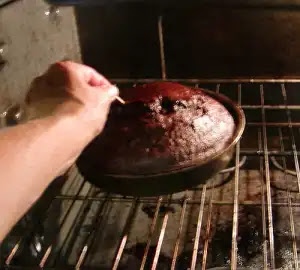

Make certain that your oven is calibrated properly. Most electric ovens get hotter over time so that they are baking at about 375F when you put the dial on 350F.

If you are mechanically inclined you can fool around with the thermostat inside the oven and adjust it in the right direction a tiny bit. We do this when we get another oven or when our oven is obviously too hot. You will need a good digital or oven thermometer to do this and it takes time. Adjust the thermostat in the oven a tiny bit, then turn the oven on until the light goes out. Use the thermometer to test the temperature in the oven when the light goes off, adjusting the oven thermostat slightly, over and over again until you get it exactly right. It could take an entire day to calibrate your oven, but its worth it! It makes a huge difference in baking to have the oven at the right temperature. It should be a few years before it needs it again.

Please don’t ask me for exact details. All ovens are different. Hubby does this and I don’t know exactly how he does it. You can probably find out on the ‘net’.

If you know that your oven bakes hot, you can always just turn it down a smidgen. If you turn it down too far and it is baking too cool, the cake will take longer and dry out before it gets done, so be careful with that. If it bakes too hot the cake will be overdone on the outside before it gets done on the inside.

Also, if you are using a glass dish you should bake at a slightly lower temperature.


When the cake is done and removed from the oven it should cool to room temperature before frosting. I set my pans in very cold water in the sink to cool them quickly. Never, ever frost a cake that is even slightly warm. The frosting melts! You can make a fabulous cake and come back an hour later to find the second layer sliding off and sitting beside the bottom one and the frosting all pooling in the plate! (I found this out the hard way!)

When the cake has cooled completely it is ready to be frosted.

This is how I make frosting. I never use a recipe for it.

Put about 3.5 cups of powdered icing sugar in a large bowl. If making chocolate frosting, put about 1 cup of dry cocoa in with the sugar. Dont use an instant pudding mix in here to make flavoured frosting. It doesn’t dissolve. Jello that has been made and set might work well but I haven’t tried it yet.

Add about a tablespoon of vanilla or other flavour extract unless using cocoa, then you won’t need it, unless you want to add a specific flavour to chocolate frosting, like cherry. You can be creative here.

Add about this much butter.
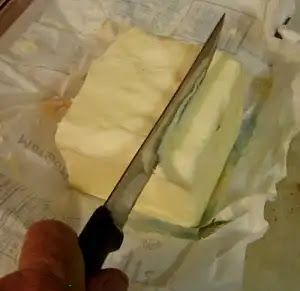

Mix it slowly on low until the butter has been fairly evenly cut into the sugar and you have a dry, lumpy mix. Then add liquid very slowly, a tablespoon or so at a time until the frosting is the right texture. Beat it on high for a few minutes.


You can use any liquid. I use coffee to make the frosting for this cake. The same coffee that I put in the cake. The flavoured coffee makes especially good frosting.

I sometimes make an orange cake, using fresh orange juice to make a white cake and using fresh orange juice to make the frosting. Carrot juice in the frosting for a carrot cake?

If you put too much liquid in the frosting, just add a bit more sugar and mix again. Add only a tiny amount of sugar or liquid at a time until the frosting is the right texture. Aim for a little too stiff as opposed to a little too soft. The frosted cake will hold together better with a stiffer frosting but it will slide if the frosting is too soft.

If you made a layer cake you will need to cut the top off of the bottom layer, making it flat. Otherwise the finished cake will be slanted. 

After cutting off the top of the bottom layer, spread frosting on it carefully. You don’t want to tear up the cake without a top on it to protect it. Set the other layer on top of this frosted one and continue to frost the top and sides of the cake.


I like to drizzle some melted hard chocolate on the top of a chocolate cake and sometimes other cakes, as well. I buy chocolate Easter bunnies on sale after Easter, chop them and put them in the freezer for this purpose. If they are chopped up and frozen other people don’t eat them.


When I am making the frosting I melt about 1/3 of a bunny (You will have to use your judgement here) in a glass measuring cup that I have put in a small pot of water on the stove. I add a few drops of oil to it while it is melting to make it smooth. You will also need to stir it a lot and watch it carefully. As soon as it melts, turn the heat off.


When the cake is frosted you can drizzle the chocolate in lines across the top or dot it on. You can also make chocolate leaves with it. If you are going to make chocolate leaves, don’t put much oil in the chocolate while it is melting. You want it to get really hard when it cools.

To make chocolate leaves you will need some clean leaves from the garden to use as a mold. Paint the melted chocolate onto the leaf tops and let them cool until they get hard. Peel the leaf off the bottom. This should leave you with a chocolate leaf you can arrange on the top of the cake. I don’t usually have the time to do this.


This cake is especially good with handmade, chemical free black cherry wine! You can even use this in the cake instead of coffee. You can put it in the frosting too, if no children are eating it. The frosting doesn’t get heated so all the alcohol will remain in the frosting to be eaten. (Warn people before they eat it!)


If you keep an apple in the container with a cake, it will help to keep it moist.

Its not a miracle worker, however. If you don’t keep the cake well sealed, it will still dry out.

Most cakes freeze well, too, if sealed properly. Freeze half of it if you don’t think it will be eaten in a week.

Make your own yogurt


My Yogurt Maker
You can make your own yogurt at home. The most common yogurt makers are electric and have little cups that the yogurt is made in. I always thought that little bit of yogurt would be more trouble than it was worth. I bought a non-electric yogurt maker that holds two litres of yogurt and it works great! For the same amount of trouble and time, I can make a lot more yogurt. This type of yogurt maker is called a "Yogotherm" and can be bought many places online. 


If you want thick "Greek" yogurt, you would make it by the recipe below, then drain it in cheesecloth until it's as thick as you want it to be. You could even drain it enough to make cream cheese! (See my post on "Making Your Own Cream Cheese".)


Below is the recipe I use to make yogurt. It doesn't hurt to bring the milk to a boil. I have read that it even helps make it thicker. It's the cooling down temperature that's important. If you add the starter yogurt when the milk it too hot, it will kill the bacteria that makes the yogurt. I always use a little yogurt as the added starter for next time. You can use a bit saved from your last batch, for awhile. After a few batches, you should buy new starter yogurt or yogurt starter in powdered form. I just buy a little container, even if it's sweetened fruit yogurt. The very little ones that are only a few bites, are enough starter. If you can find it plain, that's even better. The yogurt you make will be totally unsweetened, of course. You can add whatever you like to the yogurt before you put it in the maker, but I would be careful not to add anything that's going to hinder the growth of the bacteria. 
 

If you don't want it to separate a lot and aren't making cheese with it, the addition of a couple of tablespoons of plain gelatin will help keep it solid longer. (Dissolve the gelatin in a little boiling milk or water before adding it.) Less whey to drain off each time before you eat it. It will still water a little, but not nearly as much. I don't do this anymore, as I like to drain the whey off to make very thick "Greek" yogurt or cream cheese. 
 
To Make Yogurt:  
 
Ingredients & Equipment
  • Milk: 1 quart (or 1/2 gallon) of whole, 2%, or skim milk.
  • Starter: 2–3 tablespoons of plain yogurt containing "live and active cultures" per quart of milk, or a freeze-dried starter culture.
  • Equipment: Pot with lid, thermometer, whisk, and jars or a container for incubation. 
Step-by-Step Instructions
  1. Heat the Milk (Scald): Pour milk into a pot and slowly heat to 180°F–190°F (82°C–88°C). This kills wild bacteria and denatures the whey proteins for a thicker, smoother texture
    .
  2. Cool the Milk: Remove from heat and let it cool down to 110°F–115°F (43°C–46°C). You can speed this up by placing the pot in an ice-water bath. If you don't have a thermometer, it should feel pleasantly warm (not scalding) to your finger for 10 seconds.
  3. Add the Starter: In a small bowl, whisk the yogurt starter with a small amount of the warm milk until smooth. Pour this mixture back into the main pot and stir gently to combine.
  4. Incubate: Cover the container and keep it warm (around 110°F) for 6–12 hours.
    • Methods: Use a yogurt maker, the "Yogurt" setting on an Instant Pot, a slow cooker, or put the jar in the oven with the light turned on.
    • Note: The longer it incubates, the firmer and tangier it becomes. I usually let it sit overnight, about 8-10 hours.
  5. Chill: Once set, transfer the yogurt to the refrigerator and chill for at least 4 hours before eating. 
How to Make Greek Yogurt
To make thick Greek-style yogurt, line a fine-mesh strainer with cheesecloth or a large coffee filter, place it over a bowl, and pour the set yogurt into it. Let it drain in the refrigerator for 2–8 hours to reach your desired consistency. 
Tips for Success
  • Save for Next Time: Reserve 1/4 cup of your homemade yogurt to use as the starter for your next batch.
  • Avoid Over-stirring, moving or any agitation during incubation: Too much agitation during the setting process can make the yogurt runny.